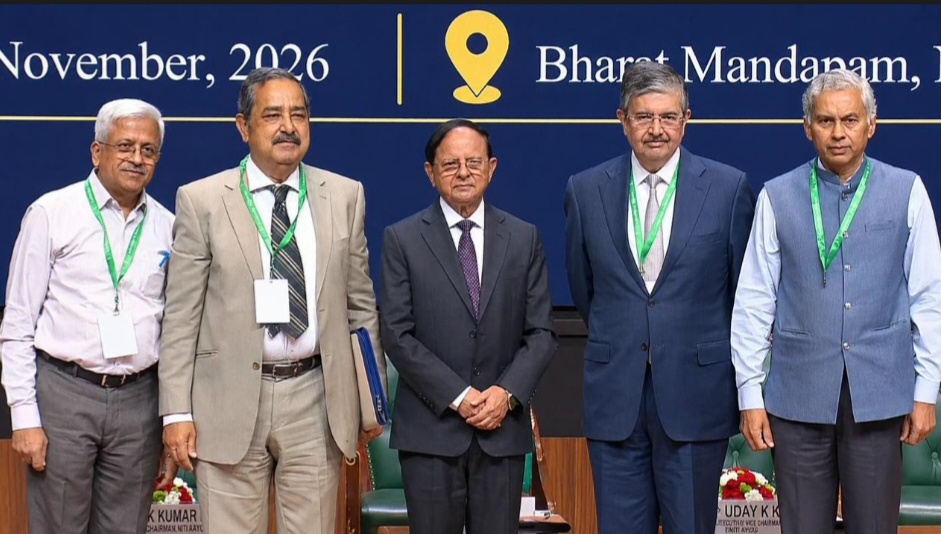
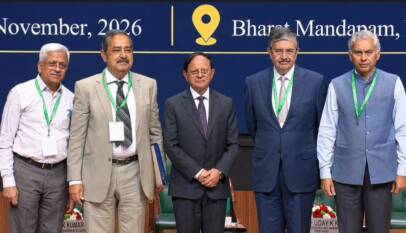
NITI Aayog holds first National Workshop on “Leadership as a Mission” on the completion of 25 years of Prime Minister Shri Narendra Modi as Head of Government
Dr. P.K. Mishra, Principal Secretary to the Prime Minister, delivers inaugural keynote address at Bharat Mandapam, New Delhi

New Delhi: NITI Aayog organised the National Workshop on “Leadership as Mission” at Bharat Mandapam, New Delhi today, to draw on the learnings from the twenty-five years of Prime Minister Shri Narendra Modi as Head of Government. The Prime Minister assumed office as Chief Minister of Gujarat in October 2001 and as Prime Minister of India in May 2014 and has led the Government at the State and the Union levels without a break since then. Throughout this period, he has held public office as a mission of service. His description of himself as the Pradhan Sevak places the citizen at the centre of every office of government, and the principles of Antyodaya, Jan Bhagidari and Sabka Saath, Sabka Vikas, Sabka Vishwas, Sabka Prayas have guided the direction of governance at both levels.
The workshop is the first in a series of five National Workshops. The deliberations and first-hand experiences shared during the series will be developed into case studies and learning material for civil services training institutes, educational institutions and universities. Over the course of the series, the learning from these twenty-five years will also be taken forward through research and teaching material that sets out directions for policy and administration in the years leading up to Viksit Bharat @2047.
More than 900 participants attended the workshop, of whom 250 took part directly in the deliberations. The participants included Secretaries and senior officers of the Union and State Governments, District Collectors of Aspirational Districts, students of educational institutions and universities, and community partners and beneficiaries of national flagship schemes. The proceedings are also streamed on the iGOT Karmayogi platform and at Central and State Administrative Training Institutes, enabling officers from across the country to participate in the programme.
The workshop commenced with the National Song and the National Anthem followed by welcome address by Shri Anurag Jain, Chief Executive Officer, NITI Aayog. He highlighted that the objective of this workshop is to document the learnings from 25 years of leadership of the Hon’ble Prime Minister and translate them into institutional knowledge for the future.
He outlined four key lessons from the leadership journey. First, purpose must take precedence over hierarchical position, shifting the focus from individual leadership to a shared collective mission. Second, service must replace command, with governance centred on reaching the last person in the queue. Third, intrinsic conviction builds resilience, enabling adversity to become an opportunity for societal transformation. And fourth, true empowerment must outlive individual leadership through strong institutions, capable teams and sustainable systems.
Shri Ashok Kumar Lahiri, Vice Chairman, NITI Aayog, delivered the opening remarks. He said, “The role of strong political and administrative leadership is crucial in driving India’s development journey. The transformational vision of our Hon’ble Prime Minister, marks a significant shift in India’s national aspiration to become Viksit by 2047, reflecting the country’s transition towards a developed, prosperous and globally competitive nation.”
He highlighted NITI Aayog’s integrated roadmap for realising this ambition of building a USD 30-40 trillion economy by 2047, with a per capita income of USD 15,000-18,000, supported by sustained annual real GDP growth of 7-10%.
Delivering the inaugural keynote address, Dr. P. K. Mishra, Principal Secretary to the Prime Minister, said that “India’s governance journey has been marked by defining milestones that demonstrate the power of decisive leadership and the ability to translate vision into action. From swift response to the 2001 Kutch earthquake to the country’s coordinated response to the COVID-19 pandemic, from expanding India’s footprint in the global space economy to the transformative impact of Lakhpati Didi initiative, these actions reflect how strong political will, responsive administration and mission-driven governance can bring about meaningful change in people’s lives.”
Shri Uday Kotak, Founder, Kotak Mahindra Bank, said that “The leadership of Hon’ble Prime Minister Shri Narendra Modi, both as Chief Minister of Gujarat and subsequently as Prime Minister of India, has consistently recognised entrepreneurship as a key driver of economic growth and nation-building. The institutionalisation of support systems, strengthening of financial and entrepreneurial ecosystems, and the emergence of a vibrant start-up landscape reflect this commitment.”
Dr. R. Balasubramaniam, Member, NITI Aayog, explained the design and structure of the workshop. He stated that the workshop approaches leadership through the decisions and actions in which it becomes visible, with the day’s proceedings structured to move from experience to analysis and from analysis to practice. The proceedings followed five stages: Learn, Analyse, Reflect, Apply and Commit under which participants learnt from first-hand accounts of significant decisions, analysed them through deliberations involving government, academia and citizens, reflected on enduring practices of public leadership, applied the learning to challenges in their own work and committed to specific changes in their leadership practices. He added that the workshop seeks to build an Indian body of knowledge on public leadership, drawing on Indian decisions and institutions, which will shape the way civil servants are trained and the way they lead in the years towards Viksit Bharat 2047.
During the Leadership Moments session, four speakers shared first-hand accounts of key moments and the leadership lessons emerging from them.
Shri Rajeev Topno, Additional Chief Secretary and Principal Secretary, Health and Family Welfare Department, Government of Gujarat, spoke on the reconstruction of Kutch following the 2001 earthquake. He highlighted that, Kutch 2001 was not merely a story of restoring normalcy, it was a story of creating a new normal through Jan Bhagidari, institutional strength and collective resolve. The experience highlighted four key pillars of effective governance, clarity and decisiveness in vision, solidarity and commitment, people’s participation with State support, and strong institution building.
Ms. Preeti Sudan, former Union Health Secretary and former Chairman, UPSC and former Member, Independent Panel for Pandemic Preparedness and Response, emphasised that under the leadership of Hon’ble Prime Minister Shri Narendra Modi, India’s COVID-19 response evolved from a whole-of-government approach into a whole-of-society movement. With the safety of doctors, nurses and frontline warriors prioritised, technology as its backbone, and Jan Andolan driving public participation, India mounted a coordinated response. Through Vaccine Maitri, the country further extended its commitment to global solidarity, supplying approximately 300 million vaccine doses to over 100 countries.
Shri Shailesh Kumar Singh, former Secretary, Ministry of Rural Development, Government of India said that “The Lakhpati Didi initiative is an example of how a vision can be translated into action at an unprecedented scale. The Hon’ble Prime Minister recognised rural women as entrepreneurs, producers and service providers, giving the initiative a clear and ambitious goal. Lakhpati Didi initiative goes beyond income generation, it is about fostering economic independence, dignity and recognition for women within their families and society. That, to me, is its larger purpose.”
Dr. S. Somanath, former Chairman, ISRO and former Secretary, Department of Space, Government of India, highlighted how liberalised FDI norms have opened new avenues for private sector participation, enabling space to emerge as a significant contributor to the economy. He emphasized that ISRO is playing a crucial role in facilitating this transition by extending its expertise, infrastructure and facilities to private players. Looking ahead, India’s Space Vision 2047, will further advance our scientific capabilities and strengthen India’s position as a global space power.
Following the session, participants took part in the Case Clinic, where each group examined a specific decision from its assigned episode. Each group comprised of government officers, community partners and students, and was guided by a case writer trained under the Amrit Gyaan Kosh initiative of the Capacity Building Commission. The group deliberations, together with the first-hand accounts shared by the speakers, will be developed into case studies by the Capacity Building Commission and made available on the iGOT Karmayogi platform for use by civil servants, training institutions and universities.
Later in the day, a panel discussion on “Leadership for Viksit Bharat” will be held and government officers will take part in the Application Clinic. Dr. T.V. Somanathan, Cabinet Secretary, will launch the Karmayogi Sankalpa and deliver the closing remarks.
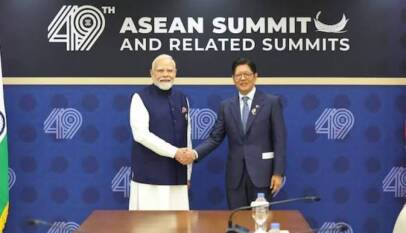

Prime Minister meets with the President of the Republic of the Philippines on the sidelines of ASEAN Summit in Manila
New Delhi: Prime Minister Shri Narendra Modi met H.E. Ferdinand R. Marcos Jr., President o…
NITI Aayog holds first National Workshop on “Leadership as a Mission” on the completion of 25 years of Prime Minister Shri Narendra Modi as Head of Government
New Delhi: NITI Aayog organised the National Workshop on “Leadership as Mission” at Bharat …