Mumbai-Ahmedabad Bullet Train Project Strengthens India’s High-Speed Rail Capabilities: Govt

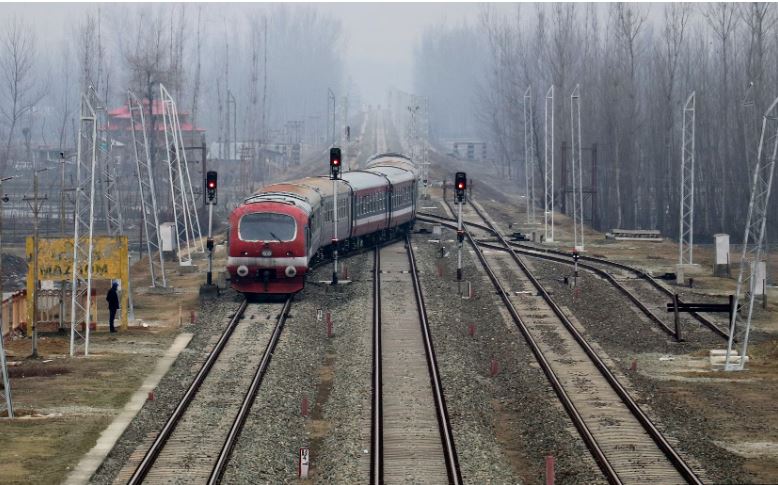
New Delhi, February 11: The experience gained from the Mumbai-Ahmedabad High Speed Rail (MAHSR) Project is laying a strong foundation for India’s future high-speed rail (HSR) network, the government informed Parliament on Tuesday.
Replying to questions in the Lok Sabha, Union Minister for Railways Ashwini Vaishnaw said the 508-km MAHSR corridor, being executed with technical and financial assistance from the Government of Japan, is significantly boosting India’s domestic manufacturing, engineering capacity and technological expertise.
The minister said indigenisation efforts under the project have strengthened India’s capabilities in heavy construction machinery, slab track materials and specialised track machines. Long-span steel truss girders are being fabricated in Indian workshops, while most slab track components are being developed domestically.
Around 1,000 Indian engineers and skilled workers have been trained in Japanese high-speed rail methodology, and track works are now being executed under their supervision. A special track training facility has also been set up in Surat for continuous skill development.
The project has introduced several innovations, including the use of full-span launching technology for 40-metre prestressed box girders, enabling faster construction. Indigenous noise barriers, advanced simulation tools developed with IIT Delhi, and a Rail Turnover Prevention Device (RTPD) to enhance derailment safety have also been incorporated.
The MAHSR corridor will have 12 stations across Gujarat, Maharashtra and Dadra & Nagar Haveli — including Mumbai, Thane, Virar, Boisar, Vapi, Surat, Vadodara, Ahmedabad and Sabarmati. Stations are being designed as city gateways with advanced security systems, anti-vibration measures and sustainable features aligned with Indian Green Building Council standards.
The government informed that the entire 1,389.5 hectares of land required for the project has been acquired and all statutory clearances obtained. As of now, major civil works in Gujarat have progressed significantly, with foundation work completed over 352 km and girder launching over 331 km. In Maharashtra, foundation work has reached 74 km.
Seventeen river bridges have been completed, and work is progressing on major bridges including Narmada, Mahi, Tapti and Sabarmati. Excavation at the Bandra Kurla Complex (BKC) station has reached 91 percent completion, and work on the 21-km under-sea tunnel has begun, with 4.8 km already completed.
The minister stated that ₹86,939 crore has been spent on the project till December 31, 2025.
In line with the Make in India and Aatmanirbhar Bharat initiatives, Indian Railways is also promoting indigenous manufacturing of high-speed train sets. The Integral Coach Factory, in collaboration with BEML, is designing and manufacturing trains with a design speed of 280 kmph.
On Dedicated Freight Corridors (DFC), the government informed that the Eastern DFC (1,337 km) has been fully commissioned, while 1,404 km out of 1,506 km of the Western DFC has been completed. Currently, an average of 406 freight trains operate daily on these corridors.
The government said the viability of the bullet train project has been assessed on a long-term basis, considering passenger demand, time savings and regional development benefits.(PIB)


Iran Criticises UN Chief Over Response to US-Israel Attacks
Tehran: Iran has strongly criticised the United Nations Secretary-General António Guterres…
Iran Criticises UN Chief Over Response to US-Israel Attacks
Tehran: Iran has strongly criticised the United Nations Secretary-General António Guterres, accusing him of …