Panchayats Must Emerge As Centres Of Innovation, Digital Governance, Public Trust: LG Sinha

Srinagar, Jun 23: Lieutenant Governor Manoj Sinha on Tuesday said Panchayati Raj Institutions (PRIs) must evolve beyond administrative units and emerge as centres of innovation, equal opportunity, sustainable development and public trust, asserting that grassroots governance will play a decisive role in realizing Prime Minister Narendra Modi’s vision of a developed India.
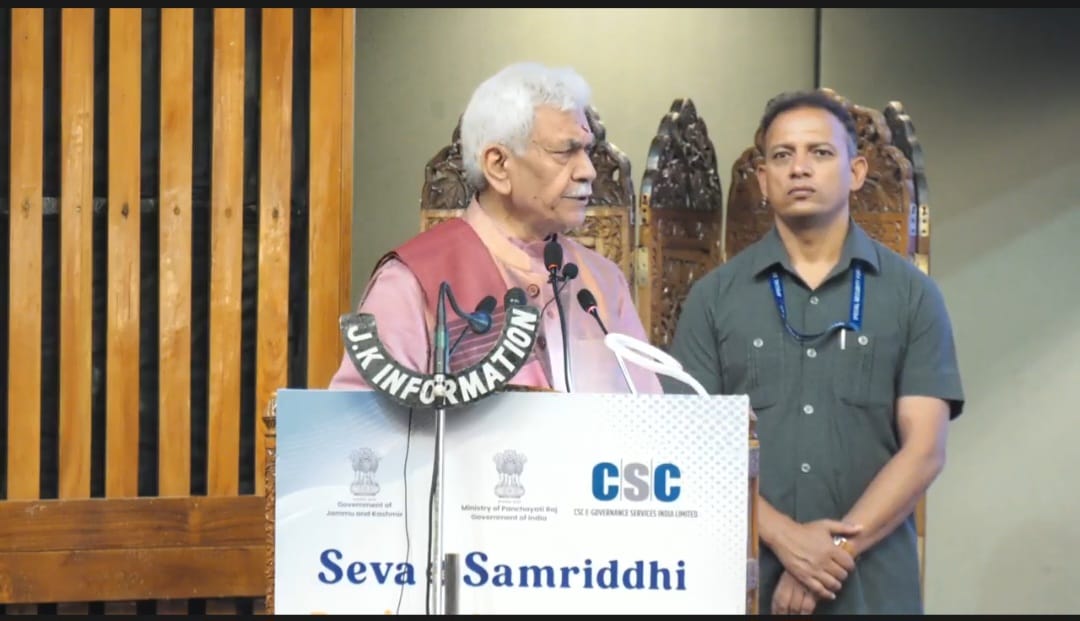
Addressing the “Seva Se Samriddhi: Regional Workshop on Panchayat-Led Service Delivery” at SKICC Srinagar, the Lieutenant Governor, welcomed delegates and Panchayat representatives from across the country and thanked the Union Ministry of Panchayati Raj for organising the workshop in Jammu and Kashmir.
He said seamless Panchayat-led service delivery is a crucial pillar of governance and reiterated the administration’s commitment to strengthening local self-governance institutions.
The Lieutenant Governor said Jammu and Kashmir lacked a fully functional three-tier Panchayati Raj system in the past, but significant efforts in recent years have empowered local bodies through the transfer of funds, functions and functionaries.
“District plans were prepared jointly with elected representatives, and development priorities identified at the grassroots level were implemented accordingly,” he said, adding that locally-driven planning had enabled the execution of several impactful projects across villages.
Recalling the early days of his tenure, Sinha said governance in Jammu and Kashmir was heavily dependent on the physical movement of files under the Darbar Move system.
“When I came to Jammu and Kashmir in 2020, I witnessed nearly 154 trucks transporting government files from Srinagar to Jammu. I was surprised that in the digital age, administration was still dependent on the physical movement of files,” he said.
He said the administration subsequently accelerated digitisation and shifted governance systems online, improving efficiency and transparency.
Highlighting achievements in e-governance, the Lieutenant Governor said more than 1,100 government services had been made available online within three years, helping J&K emerge as one of the country’s leading regions in digital service delivery.
“Technology has proven to be one of the most effective means of delivering services to citizens in a transparent and accountable manner,” he said.
Sinha said citizen outreach initiatives such as Back to Village had strengthened direct interaction between the government and the people, ensuring governance remains aligned with public aspirations.
Referring to Prime Minister Narendra Modi’s vision for rural development, he said Panchayats are central to achieving the goal of a developed India.
“A developed India cannot be imagined without developed villages. Empowering Panchayats and strengthening rural governance is essential for achieving national development goals,” he said.
The Lieutenant Governor said governance must be rooted in people’s participation, trust and accountability.
“The dreams of ordinary citizens should resonate in the heartbeat of governance,” he remarked.
Highlighting J&K’s digital transformation, Sinha said digital transactions witnessed remarkable growth in recent years, increasing from nearly two crore transactions between 2016 and 2018 to over 50 crore transactions in the first six months of 2023 alone.
He also highlighted the expansion of digital infrastructure, stating that over 15,000 Common Service Centres (CSCs) are operational across Jammu and Kashmir.
“Out of 4,290 Panchayats, 4,211 have been connected through digital networks, representing over 98 percent connectivity,” he said.
Sinha said the remaining 79 Panchayats are located in remote and border areas, where efforts are underway to ensure full digital inclusion under the Prime Minister’s Vibrant Villages Programme.
Referring to Mahatma Gandhi’s vision of self-reliant villages, the Lieutenant Governor said the Panchayati Raj system is deeply rooted in India’s democratic traditions and civilisational heritage.
He also welcomed initiatives such as the National Panchayat Governance Awards, saying such recognitions encourage innovation, excellence and accountability in grassroots governance.
“These awards recognise Panchayats that have used digital tools and innovative practices to improve public service delivery and strengthen public trust,” he said.
Calling for a structured framework to share successful governance models, Sinha said best practices developed in one region should be replicated across the country to strengthen governance and national unity.
He further advocated establishing Village Innovation Labs in Panchayats across India to nurture local talent and generate grassroots solutions.
“Can we create innovation labs in every Panchayat? Such platforms can provide opportunities to local youth, farmers, educational institutions, scientists and social organisations to develop practical solutions for local challenges,” he said.
The Lieutenant Governor said India’s governance model should be guided by unity in diversity, cooperation in action and commitment to public service, adding that future-ready Panchayats must ensure easy access to digital services, participatory decision-making and greater accountability.
“We need Panchayats where governance is not imposed from above but shaped by local communities and citizens themselves,” he said. (KNO)

Use earphones or face fines, jail: Railway zones to educate passengers on mobile phone nuisance
New Delhi: Railway zones will spread awareness among passengers through public-address sys…

Use earphones or face fines, jail: Railway zones to educate passengers on mobile phone nuisance
New Delhi: Railway zones will spread awareness among passengers through public-address systems, urging them …